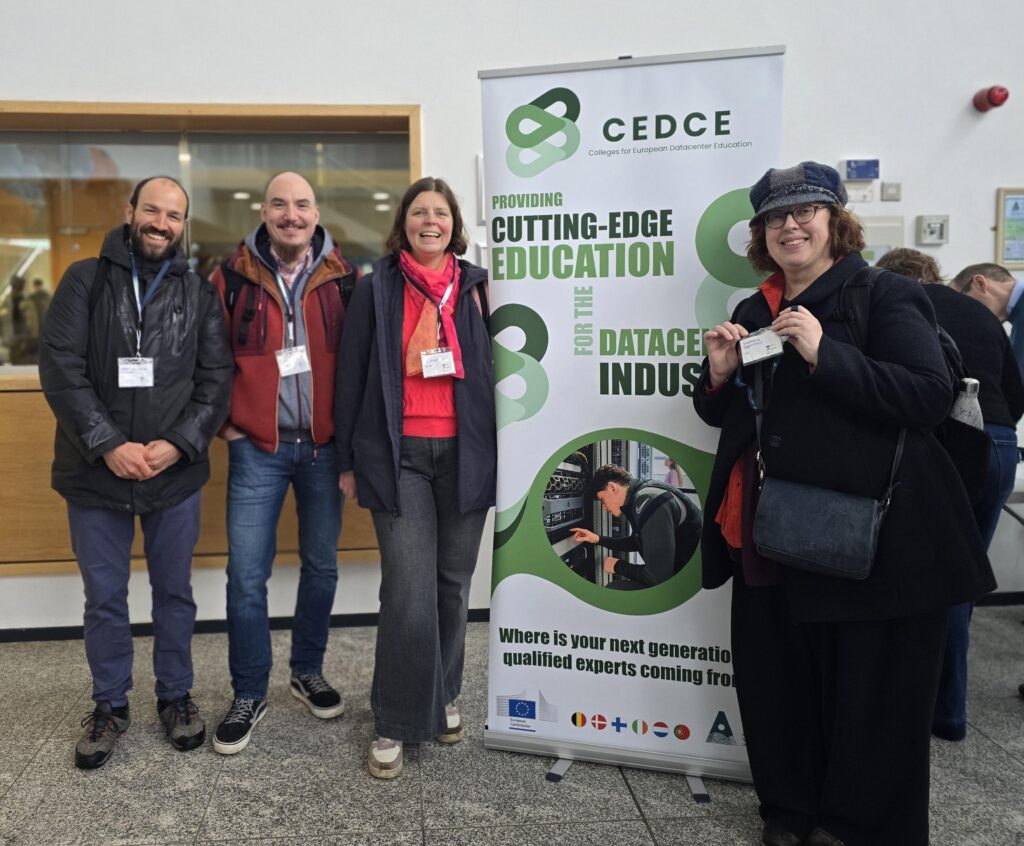
For several years, HELHa, through its Engineering School, has been actively involved in training for careers in the data centre sector. From March 9 to 12, Vesna Jerkovic, Denis Hiernaux and Stéphanie Eggermont travelled to Ireland to meet with HELHa’s partners.
Training aligned with real industry needs
The data centre sector is experiencing rapid growth and requires increasingly specialised skills. To meet these demands, the industry collaborates with an international network of higher education institutions and specialised companies.
It is within this context that HELHa has developed an international continuing education programme, supported by several major industrial partners in the sector.
Vesna Jerkovic explains:
“The Data Center programme is an online course taught in English and designed for an international audience. It has had a strong impact on our Engineering School. Our close collaboration with industry to keep the programme up to date has benefited the entire school, our lecturers, our students, and our laboratories. Opening our programmes to an international online audience also allows us to develop new teaching approaches. The programme is open to our final-year students, giving them an additional skill set. We also organise a student exchange week with our partners on this topic.”
These collaborations have enabled investment in specialised teaching equipment—high-voltage systems, electrical infrastructure technologies, cooling systems such as cooling towers, and more offering both students and professionals a learning environment closely aligned with real-world conditions.
CEDCE: a European consortium structuring education
HELHa is now a partner in the European project CEDCE (Colleges for European Data Center Education).
This consortium brings together higher education institutions, vocational training centres, and industry stakeholders with a clear objective: to build a European training ecosystem dedicated to data centres.
Denis Hiernaux explains:
“It is thanks to this project that I joined HELHa. I worked for many years in industry, both in data centres and in medical radiotherapy. I now supervise projects for second-year Industrial Engineering students.”
Eight educational institutions from Belgium, the Netherlands, Ireland, Denmark, Finland, and Portugal are currently involved, alongside a wide network of companies.
CEDCE aims to bridge the gap between industry needs and training provision by designing up-to-date programmes tailored to emerging professions linked to digital infrastructure.
Stéphanie Eggermont adds:
“Taking part in these exchanges is extremely valuable. It allows us to visit partner laboratories, share both technical and pedagogical approaches, and engage directly with professionals in the field to better understand current challenges. The integration of AI in data centres and the growing importance of physical security are reshaping training perspectives.”
The project is funded by the European Union as part of a programme supporting the development of centres of vocational excellence, with a strong focus on the technical skills required for the data centres of tomorrow.
Why do data centres require specialised training?
Often perceived as simple IT infrastructures, data centres are in fact complex industrial environments.
Their operation involves a wide range of technical skills, including:
- Power supply and high-voltage infrastructure
- Cooling systems and thermal management
- Control systems, automation, and monitoring
- Physical security and service continuity
- Operational management and maintenance
This complexity requires professionals who can understand the interaction between these systems—well beyond the IT dimension alone.
Objectives of the CEDCE project
Over a four-year period, CEDCE aims to:
- Develop European training pathways from technical secondary education to higher education
- Create shared educational content aligned with real industry needs
- Strengthen collaboration between schools, training centres, and companies
- Encourage mobility among students and staff across Europe
- Build a structured skills ecosystem dedicated to data centres in several European regions
The ultimate goal: to prepare a new generation of experts capable of designing, managing, and operating the critical infrastructures at the core of the digital transition.
A consortium bringing together major European partners
The academic partners involved include:
- HELHa (Belgium)
- Atlantic Technological University (Ireland)
- Alfa College (Netherlands)
- Mercantec (Denmark)
- EKAMI (Finland)
- ETLA (Portugal)
- UCL Denmark (Denmark)
- FMS Denmark (Denmark)
These institutions collaborate with numerous industrial stakeholders specialised in the design, construction, and operation of data centres.
A constantly evolving dynamic
Throughout the project, partners meet regularly to:
- Monitor ongoing actions
- Share teaching experiences
- Coordinate the development of new training content
- Strengthen links between academia and industry
These meetings also help prepare future stages of the project and shape the evolution of data centre education in Europe.
Denis Hiernaux concludes:
“Meeting at the mid-term evaluation stage with all key partners both academic and industrial highlighted the significant work accomplished over the past two years:
- More than 25 new public-private partnerships across six European countries
- The development of a structured training framework and standards for the data centre sector in Europe, with over 10 co-created training programmes
- The launch of technical student exchanges focused on data centre topics, with more than 50 students already participating a number expected to double by the end of the academic year, with further expansion planned for 2026–2027.”
👉 Find out more about the programme on HELHa’s website: www.datacenter.helha.be


Published on 12 March 2026
Sciences and Life Technologies