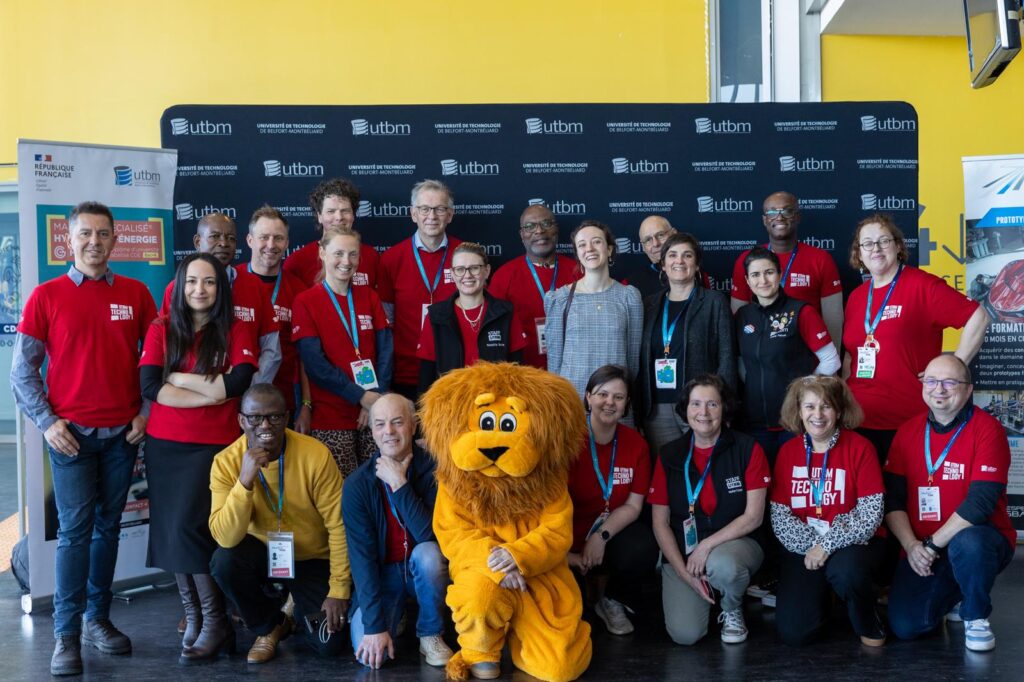
As part of an Erasmus+ exchange, three lecturers from HELHa had the opportunity to take part in the 2026 edition of Crunch Time, organised by the Université de Technologie de Belfort-Montbéliard (UTBM).
Discovering Crunch Time from the inside
Crunch Time is an intensive learning format where students, working in multidisciplinary teams, tackle real-world challenges proposed by companies or institutions over several days.
Throughout the week, the team experienced this programme from multiple perspectives:
- as coaches, supporting 16 student teams
- as project leaders, by proposing a challenge from a research centre
- as participants, by experiencing Crunch Time from a student’s point of view
This multi-layered immersion provided a deep understanding of the different stages of the innovation process: ideation, selection, prototyping, and pitching, as well as group dynamics and motivational drivers.
“It’s really rewarding to support students through the ideation process and then reconnect their ideas to the real-world context in which they will be applied, with a client who may change their mind or introduce new constraints. It was also particularly enriching to experience Crunch Time from the inside, with the perspective of developing a similar innovation activity at HELHa,” explains Philippe Mac Callum, lecturer in Science, Technology and Life Sciences in Tournai.
Experiencing innovation as a project leader
As part of Crunch Time, the HELHa Research and Continuing Education Centre (CeREF) proposed a project focusing on blood sampling in children, which was assigned to two teams: one from UTBM and one international team.
The results were particularly rich, highlighting a wide diversity of ideas and approaches.
“This experience helped us understand that a good innovation project is not simply about finding a solution-innovation can only happen if you give it space. The key is to create the right framework for ideas to emerge. And for that, it’s essential to strike the right balance: neither too vague nor too restrictive,” says Stéphanie Eggermont, also a lecturer in Science, Technology and Life Sciences.
Experiencing Crunch Time like students
The team also took part in an immersive “autocrunch” workshop, allowing them to experience Crunch Time from a student perspective.
This hands-on activity made it possible to go through all stages of the innovation process within a short timeframe.
Philippe Mac Callum adds:
“This immersion was extremely valuable. It allowed us to truly understand what students experience and to adjust our support accordingly. We could clearly see the stages they go through, their doubts, their obstacles… and that changes everything in the role of a coach.”
Understanding the mechanisms of innovation
HELHa lecturers also took part in the Innovation Fresk, an interactive workshop designed to explore the different stages, barriers, and drivers of innovation.
“This type of activity helps us better understand where innovation comes from and the levers we can use to encourage it. It’s a great tool to share with colleagues who want to engage more in research, for example. It’s extremely powerful for structuring reflection,” explains Stéphanie Eggermont.
🌱 An inspiring experience for the future
This immersion provided valuable insights into how large-scale innovation programmes operate, while also identifying concrete ways to evolve teaching practices.
It also opens up new perspectives for European collaboration and the development of similar initiatives, built on collective intelligence and experimentation.
A strong European dimension with the UPSIDED project
Alongside this week, a meeting was held for the European project UPSIDED, coordinated by UTBM.
“For me, this meeting was a great opportunity to meet the UPSIDED project partners for the first time. The Crunch Time environment, based on collective intelligence, really helped clarify the project’s objectives and reflect concretely on its future,” explains Charlotte Saussez.


Published on 3 April 2026
Sciences and Life Technologies